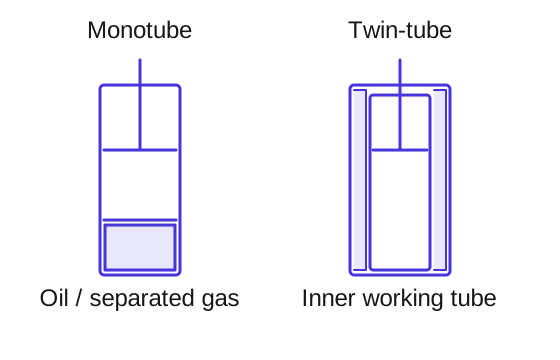
The working tube and reservoir
In a twin-tube damper, the piston works in an inner tube with a reservoir around it. A monotube uses one working cylinder; the common gas-pressurised layout separates oil and gas with a dividing piston. The schematic shows these broad arrangements without reproducing any particular kit’s valve stack.
Gas pressure is part of the design
Both constructions can use gas pressure. Seeing “gas” in a description does not identify a damper as monotube. The pressurisation, piston and valves work as a system with the oil and available stroke. Tube count alone leaves most of that specification unanswered.
Bilstein’s construction explanation illustrates the two layouts. TEIN describes FLEX Z as twin-tube. Those examples establish how the terms are used; they do not mean every product from either manufacturer has the same construction.
Compare the complete application
Look at the stated construction beside the spring rates, mounts and adjustment method for your car. Then consider how much setup you want to do and whether replacement or service options suit your ownership plans. A road kit and a competition kit can have different priorities even when both use the same tube arrangement.
Ask about the result you want
If the present car feels abrupt over broken roads, describe the surfaces, tyres and existing settings. If track use is the priority, include the circuit use and vehicle changes. We can compare the actual ranges for that application. Choosing solely by a construction label can overlook a more useful difference in spring or damper specification.
Technical references
Reviewed 24 October 2026. Manufacturer material may cover other markets or applications. Confirm the specification supplied for your UK kit.